
The hard drive was supposed to be the boring part of the parts list, the technology that got cheaper every year, forever. That stopped in the fall of 2025.
A 4TB WD Blue that sold for $67-85 in September 2025 listed at $99 by February 2026. German retail trackers put the average hard drive about 51% higher than a year ago, and the big datacenter drives that anchor the market are up 100-200% from 18 months back. This article covers what happened, why it happened when it did, and what has to change before drive prices come back down.
For live numbers while you read, our best price per terabyte hub ranks every drive class we track by live $/TB, and the internal HDD and external HDD price lists show what retailers are charging today.
Yes, prices really have risen: here's the shape of it
One year of tracked retail prices tells the story:
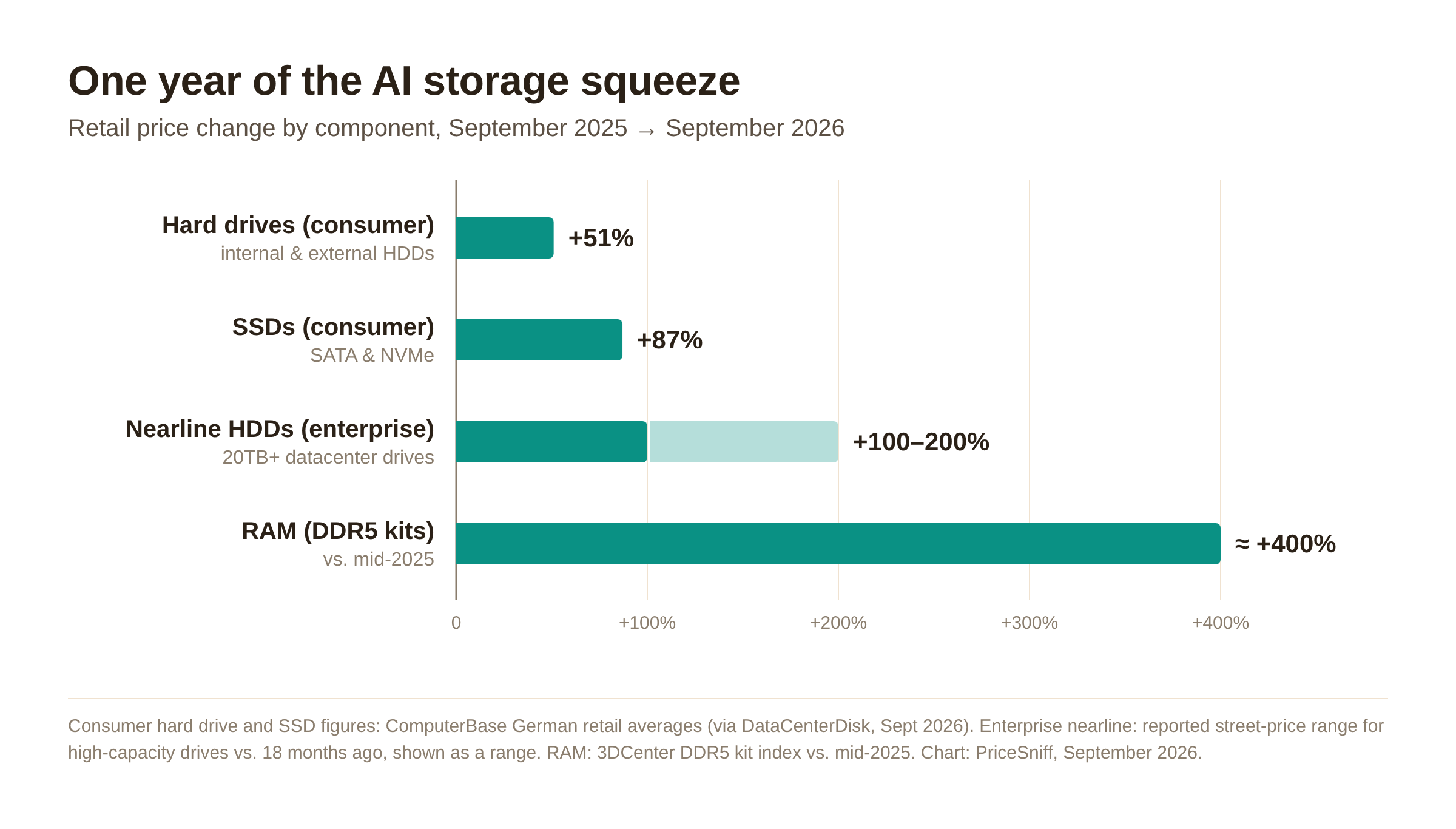
Two things jump out. First, every kind of storage and memory got more expensive at once. This is not a hard-drive-specific problem, and hard drives have actually risen least among the components caught in it.
Second, the steepest increases sit at the datacenter end. High-capacity "nearline" drives, the 20TB-and-up models cloud providers buy by the hundred thousand, roughly doubled or tripled in street price, with lead times on new orders stretching past 52 weeks.
The consumer market feels that pressure secondhand. When a hyperscaler locks up next year's nearline production, the drives that would have become shucked externals, NAS drives, and channel inventory simply don't exist, and retailers reprice what's left. That's how a 4TB desktop drive, a product with no AI story of its own, ends up 16-48% more expensive in five months.
What the market looks like right now on the drives we track:
When it started, and why: AI bought the output
The turn came in September 2025. That's the month both German retail trackers and US price watchers mark as the start of the climb, and it lines up with the quarter AI datacenter orders swallowed the industry's capacity.
By early 2026 the situation was blunt enough that both manufacturers said it out loud. Western Digital's CEO told investors the company is "pretty much sold out for calendar year 2026," with firm purchase orders from its top seven customers covering the year and some agreements already reaching into 2027 and 2028. Seagate's CEO said the same thing in the same week: nearline capacity fully allocated through calendar 2026.
Why AI needs this many hard drives is less obvious than why it needs GPUs. Training and serving models happens on flash and memory, but everything AI companies keep (the training corpora, checkpoints, logs, and the exabytes of data generated by AI products themselves) lands on nearline hard drives, which still cost several times less per terabyte than datacenter SSDs.
Industry estimates put about 18% of the roughly 2,000 exabytes of hard drive capacity shipping in 2026 directly into AI infrastructure, stacked on top of ordinary cloud growth that was already consuming most of the market. Nearline drives are now 87% of Seagate's hard drive sales, and Western Digital gets 89% of its revenue from cloud customers. Consumer retail, at about 5% of Western Digital's business, is a rounding error to the people setting production plans.
The other half of the explanation is supply, and it's the half that makes this shortage different from a demand blip. Hard drives are a two-company market for practical purposes, and both companies spent 2023 cutting production and mothballing capacity after the post-pandemic glut nearly drowned them. When AI demand arrived, they chose (explicitly, on earnings calls) not to build new factories.
Seagate prioritizes squeezing more terabytes out of each drive over adding unit capacity, and has said it can fulfill only half to two-thirds of near-term demand. Having been burned by every previous cycle, the manufacturers are letting scarcity set the price. It shows in the numbers: contract prices posted their largest quarterly increase in two years, and Western Digital has told customers to expect gradual price increases across its whole hard drive line.
If you're wondering whether you can just sidestep the whole mess with an SSD: you can't, not on price. NAND flash is caught in the same AI buildout, and consumer SSD prices have actually risen faster than hard drive prices over the same year.
SSD prices are climbing too, and worse than hard drives. See why SSD prices are going up in 2026 for the NAND-specific numbers, the timeline for relief, and what to do about it if you're choosing between an SSD and a hard drive right now.
RAM has it worse still (we covered that in our RAM price article). For bulk storage, hard drives remain the cheapest terabytes you can buy. There is no cheap door out of the room.
Is there hope? Yes, but it's measured in years, not months
The honest near-term answer: prices have stopped spiking, but nobody credible expects them to fall soon.
The spike phase looks over. Most of the damage happened between September 2025 and early 2026, roughly 50% in five months, and since spring 2026 retail prices have mostly plateaued at the new level rather than kept climbing. Price-floor trackers show the same flattening: the cheapest new dollar-per-terabyte has drifted, not surged, through 2026.
But three facts block a real decline:
- The order book is already full. Both manufacturers have long-term agreements running through 2027 and into 2028. Seagate is only now opening orders for the first half of 2027, and expects nearline to stay almost fully allocated through calendar 2027. Supply relief cannot arrive before the contracts covering it expire.
- No new factories are coming. Unlike the memory industry, which is spending hundreds of billions on new fabs, the hard drive makers are deliberately not adding production lines. Capacity growth comes almost entirely from density: more terabytes per drive, not more drives.
- The demand driver is a multi-year buildout, not a spike. AI datacenter construction has years of committed spending behind it. The 2011 Thailand floods (the last great hard drive shortage) took about two years to unwind, and that was a supply accident with demand unchanged. This time demand moved permanently.
The realistic hope is what you can already see forming: increases decelerating, then a long plateau, with real per-terabyte relief arriving as density improves rather than as sticker prices dropping.
What actually has to change
Four things would bring prices down, roughly in order of impact:
HAMR has to ramp. Heat-assisted magnetic recording is the technology that grows capacity per drive without new factories. Seagate's Mozaic platform, the only HAMR drive deployed at scale, is shipping in volume at up to 44TB to two hyperscalers now. Western Digital introduces its first HAMR drives in 2026 but won't ship volume until 2027, on a roadmap that reaches 100TB drives around 2030. Every density step effectively adds industry capacity: the same platters, more exabytes. This is the most likely mechanism by which $/TB resumes falling even if drive prices don't.
Someone has to add real capacity, or credibly threaten to. A duopoly that sells out either way has no reason to cut prices. The pressure most likely arrives sideways: as NAND fab expansions land in 2027-2028, very-high-capacity QLC SSDs start competing for the cooler tiers of datacenter storage, which is the first genuine substitute nearline drives have faced. If flash gets close enough on $/TB, hard drive pricing power erodes quickly.
The AI buildout has to stop absorbing every spare exabyte. Hyperscaler orders through 2028 are contracted, but the marginal pressure on the consumer channel eases the moment AI storage demand grows slower than density does. Whether that happens in 2027 or 2030 is the biggest single unknown in any forecast.
Consumer supply has to be worth allocating. At 5% of revenue, retail gets whatever is left over. That only changes when nearline margins normalize, which loops back to the first three.
None of this needs to fully resolve for buyers to feel relief; it needs only enough slack that the manufacturers start competing for orders again instead of allocating them.
What to do about it right now
If you need bulk storage, buy used or refurbished enterprise drives. This is the escape valve the shortage hasn't closed. Datacenters retire drives on schedule regardless of market prices, so recertified and used enterprise drives (Ultrastars, Exos, ex-NetApp and Dell stock) routinely sell at a quarter to half the $/TB of new retail drives. Our internal HDD price list regularly surfaces used enterprise drives under $10/TB while new consumer drives sit at $25-35/TB. The trade-offs are real: shorter warranty, unknown hours, always check SMART data on arrival. For backup and bulk media storage, the math is still hard to argue with.
Don't wait for a crash before a purchase you actually need. With supply contracted through 2027, the plausible downside of buying now is small and the upside of waiting is mostly hypothetical. Watch for short-lived dips instead: set a price alert on the capacity you want and buy when it fires.
Right-size instead of future-proofing. The old advice, buy double what you need because it's cheap, died with the shortage. Smaller capacities (2-8TB) carry less scarcity premium per terabyte in the used market, and by the time you fill them, HAMR-era density improvements should be reaching retail.
Check $/TB, not sticker price. In a distorted market, capacity classes reprice unevenly week to week. The price-per-terabyte hub ranks every drive we track by live $/TB across internal, external, and portable classes. In a market like this one, that ranking changes often enough to be worth a look before every purchase.
The short version: if you need terabytes this year, buy them now, used enterprise first, after checking live $/TB. If you're waiting for 2025 prices to return, the contracts running into 2028 say you'll be waiting years.